You’ve Pumped Millions into AI. And Got Nothing. Here’s Why.
You already feel it, don’t you? Somewhere deep down.
You read AI headlines every day. Your competitors are launching something. The board is demanding “digital transformation”. You’ve carved out a budget, hired people, maybe even signed a contract with some firm that promised you an AI revolution.
Six months have passed. Or a year.
And nothing has really changed.
There’s a prototype that works on test data. There’s a glossy deck for investors. There’s a warm feeling that you’re “in the game”. But profit? Growth? Real change in the business?
No.
And you’re starting to suspect the problem isn’t the technology. It’s how you’re approaching it.
Let’s look at the numbers honestly. They’re sobering.
95% of AI Projects Deliver No Profit. That’s Not a Typo.
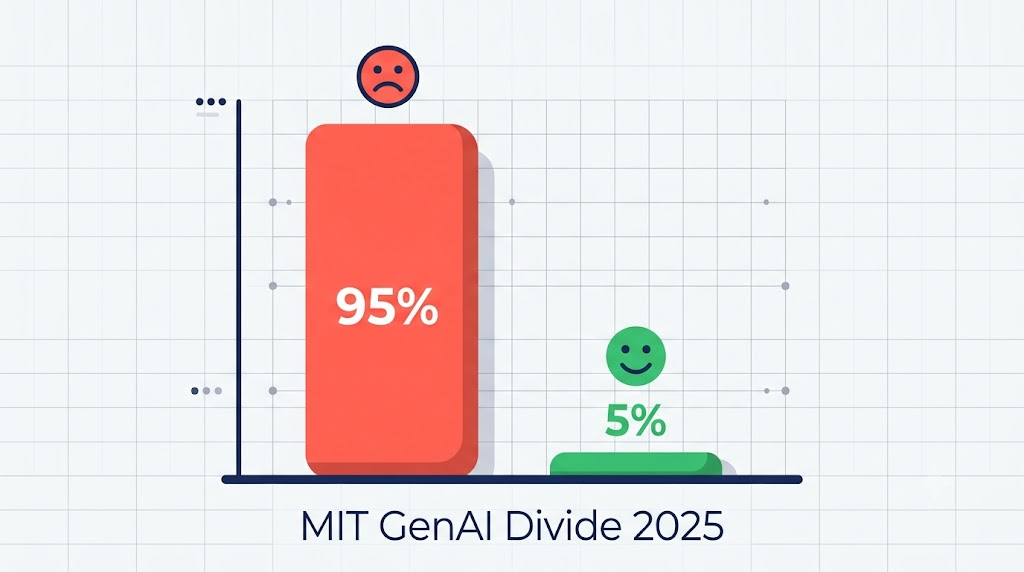
Chart – 95% AI project failure rate
Bar chart showing 95% of enterprise AI projects fail to deliver ROI, with a red bar for failures and a small green bar for successes, based on MIT research.
MIT’s GenAI Divide research tracked over 300 enterprise AI deployments and interviewed more than 350 senior leaders. Their finding? 95% of generative AI projects failed to deliver measurable ROI.
Not 50%. Not 30%. Ninety‑five per cent.
S&P Global reported in 2026 that 42% of companies abandoned most of their AI initiatives – up from just 17% the year before. Meanwhile, 79% of AI projects fail at the pilot stage or immediately after, and 65% blow past their original budgets.
In plain English: you’re spending more than you planned on things that ultimately don’t work.
And here’s the real kicker: 95% of organisations keep investing in AI, even without seeing returns.
Why? Because the fear of being left behind is paralysing. Because competitors are “doing something”. Because it feels like now or never.
But let’s pause for a second. Maybe the question isn’t whether to adopt AI. Maybe it’s how you’re doing it.
The Problem Isn’t the Model. It’s the Engineering.
Today’s AI models are genuinely impressive. GPT‑5, Claude, open‑source models – they can write, reason, generate code.
But your business problem isn’t “can the model answer questions”. The real challenge lies in European AI engineering — a structured, production-ready approach that fixes the missing links:
Data. Your data lives in CRMs, Excel sheets, Telegram chats, and your managers’ heads. It’s messy, unstructured, scattered. Models can’t work with that out of the box.
Integration. Your legacy systems don’t understand AI. They expect crisp, deterministic answers. AI gives probabilities.
Security. You can’t just ship customer data to OpenAI. GDPR, the EU AI Act, NDAs – these aren’t buzzwords. They’re multi‑million‑euro fines waiting to happen.
Operations. Training a model is half the battle. Monitoring, updating, failover – that’s where the real pain lives.
Speed. While you spend six months building the perfect solution, the market moves on. Competitors launch. Customers drift away.
That’s why 95% of projects fail. Because people buy an AI model and think that’s enough. What you actually need is an engineering solution – one that covers data, integration, security, operations, and, above all, speed.
GDPR and the EU AI Act: Not Jokes, but Multi‑Million‑Euro Fines

Illustration – GDPR and EU AI Act enforcement
Illustration of a gavel striking a pile of euros, with a GDPR badge and an AI Act document, set against a European flag background.
If you process any EU citizen data, GDPR applies to you. Full stop. It doesn’t matter where your company is headquartered. It doesn’t matter where your developer sits.
Fines: up to €20 million or 4% of global annual turnover.
And regulators are not sitting idle.
January 2026. France’s CNIL fined FREE MOBILE €27 million and FREE €15 million for inadequate subscriber data security.
Same month. FRANCE TRAVAIL (ex‑Pôle Emploi) – €5 million for insufficient protection of job‑seeker data.
May 2026. IQVIA OPERATIONS FRANCE – €5 million for mishandling health databases.
And that’s just France. Just early 2026. Just the headline cases.
Now add the EU AI Act.
From 2 August 2025, obligations for general‑purpose AI providers kicked in. From 2 August 2026, transparency obligations apply to all AI systems in the EU. That means you must label AI‑generated content, tell users they’re interacting with an AI, and keep documentation on training data.
Penalties: up to €15 million or 3% of turnover.
If your development partner sits outside Europe, they’re learning all this on your dime. They don’t live in this regulatory environment. They don’t feel it. They tick boxes, and you face the regulator.
Why Poland? Because It Works.
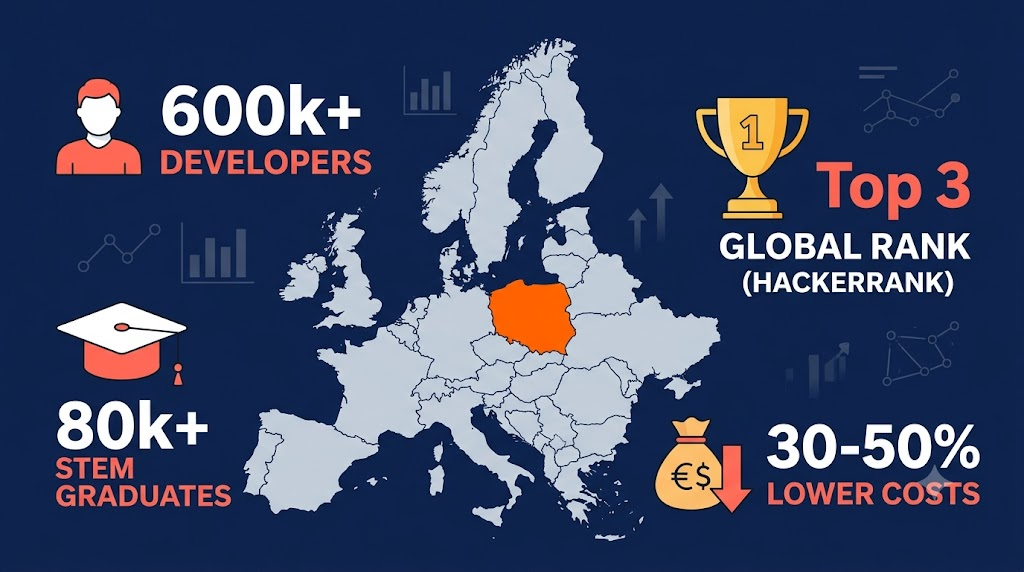
Infographic – Poland tech hub statistics
Infographic showing Poland’s tech talent: 600,000+ programmers, 80,000 STEM graduates annually, top 3 global programming quality, 30-50% cost savings, and a map of Europe highlighting Poland.
You could hire developers in Germany. They’re good. But there aren’t enough of them, they’re expensive, and recruitment is a slog.
Germany has over 100,000 open IT positions. Competition is fierce. A senior engineer commands €80,000–€120,000 per year in base salary alone – before taxes, benefits, and recruitment fees.
Or you could look east.
Poland has over 600,000 programmers – the largest IT talent pool in Central and Eastern Europe. 80,000+ STEM graduates every year. Ranked in the top 3 globally for programmer quality by HackerRank.
Yet development costs are 30–50% lower than in Germany, Austria, or Switzerland. The average hourly rate is around €17.3.
But it’s not just about money.
Time zones. Poland is CET/CEST – the same as Berlin, Vienna, Zurich. No late‑night calls. Full working‑day overlap.
Culture. Polish engineers are direct, accountable, and share a European work ethic. No “yes, we’ll do it” when they mean “no, we won’t”. No bureaucratic fluff. Just delivery.
Data sovereignty. Data stays in the EU – not in the US, not under the CLOUD Act, which gives American authorities access to data anywhere. For finance, healthcare, government – that’s a red line.
2–4 Weeks to First Release. Not Six Months.

Illustration – 2 to 4 weeks delivery
Illustration of a calendar flipping from month to weeks, with a rocket launching and a checkmark, conveying fast AI MVP delivery.
Yladick Lab is an engineering hub in Poland. We’re not freelancers, not body‑shoppers, not an agency that rebranded its web team as “AI practice”.
We’re a team of engineers who specialise in Python for AI and integrations, and C++/Qt where performance matters.
We work under GDPR, NDA, DocuSign. We invoice from an EU legal entity.
And we deliver a working release in 2–4 weeks.
Not a prototype that only runs on synthetic data. Not a Proof of Concept that can’t go to production. A working product you can show to customers, test with real data, and start gathering metrics.
How?
We don’t start from scratch. We have battle‑tested pipelines for data ingestion, feature stores, MLOps infrastructure.
We use AI to generate code, tests, and architecture checks – but humans always make the final call.
We work in 1–2 week sprints with daily demos. No “big bang” releases at the end.
We begin with an audit of your processes – and immediately see where automation will deliver the biggest impact.
Calculate How Much You’re Losing to Routine Work
Grab a calculator. Add up how many hours your managers spend answering the same questions: “How much does it cost?”, “Is it in stock?”, “When will it arrive?”
How many leads go cold because no one replied overnight?
How much data gets lost in Telegram threads and never reaches your CRM?
Yladick Lab has built AI agents that handle up to 45% of routine tasks. They work 24/7. They answer questions. They gather data. They escalate complex cases to humans.
Savings per employee – up to €6,300 per month, up to €75,600 per year.
Multiply that by your number of managers. That’s the cash you’re burning right now.
Enough Experiments. Time to Deploy.
You’ve already spent time, money, and nerves on AI experiments that went nowhere.
You’re tired of Proofs of Concept that lead to dead ends.
You don’t want to “be on trend” – you want to actually change your business.
We get it. We’re engineers who build working systems, not glossy slides.
So we won’t offer you a magic pill. We offer an honest conversation.
30 minutes. We’ll look at your process. We’ll tell you where AI will actually help – and where it won’t. We’ll give a rough estimate of timeline and budget. No strings attached.
Ready to Give It a Go?

Social teaser – 95% AI failure
Head over to Yladick Lab and book a 30‑minute consultation:
👉 https://www.yladicklab.online/en
Or drop us a line directly. We’re here.
Poland, EU. GDPR, NDA. Release in 2–4 weeks.
Your competitors are already doing something. The only question is whether they’re doing it right.
LINKS
S&P Global (оригинал): https://www.spglobal.com/market-intelligence/en/news-insights/research/ai-experiences-rapid-adoption-but-with-mixed-outcomes-highlights-from-vote-ai-machine-learning
OMMAX AI Trends Report 2026: https://www.ommax.com/en_en/insights/industry-insights/ai-trends-report-2026
Forbes (о S&P Global): https://www.forbes.com/sites/josipamajic/2026/05/25/the-ceo-ai-confidence-gap-is-costing-enterprises-billions/
Dataconomy (о S&P Global): https://dataconomy.com/2026/04/06/why-most-enterprise-ai-projects-never-reach-production/