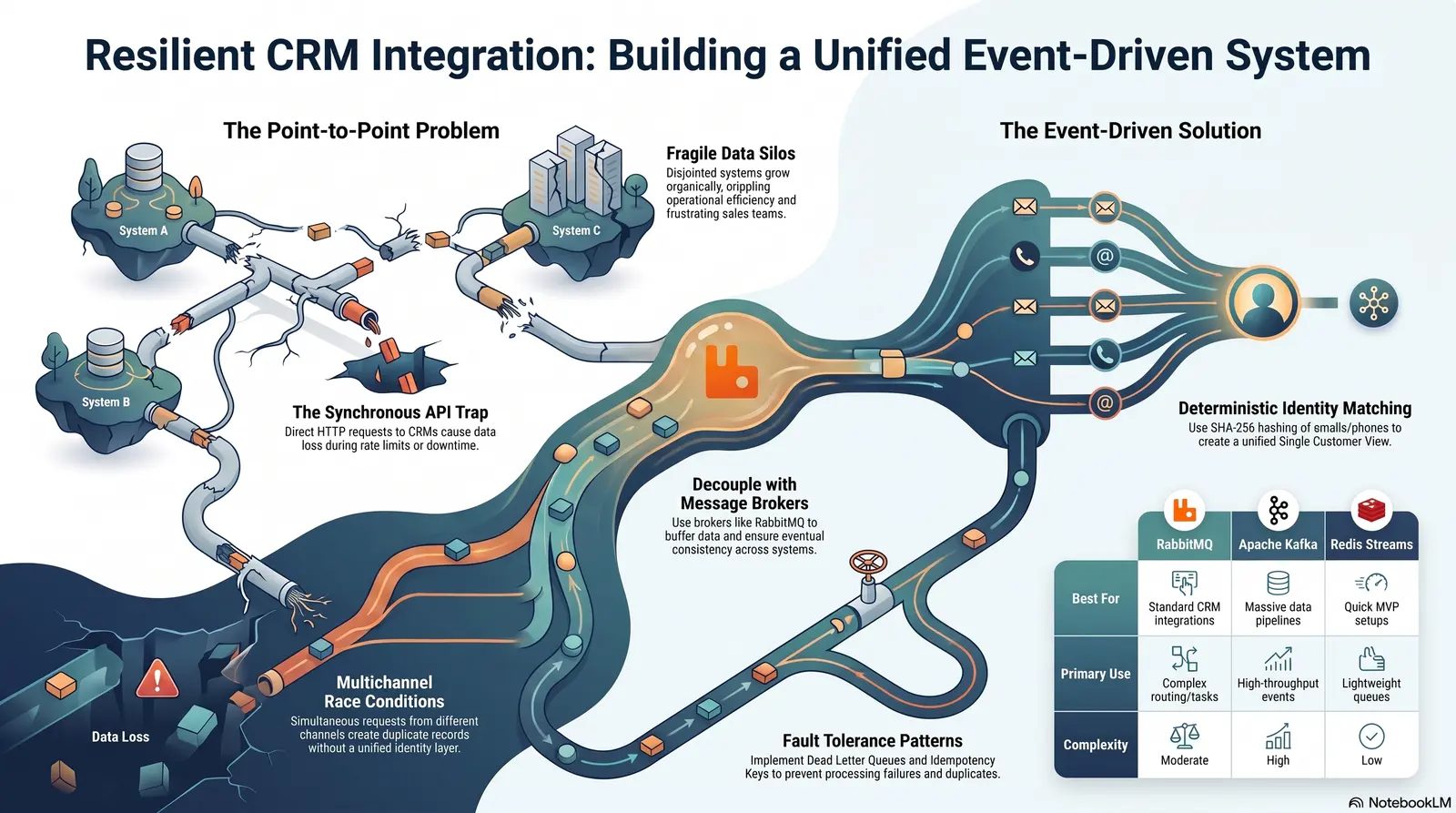
It’s 6:00 PM, Friday. Your marketing team has just launched a massive, heavily funded ad campaign. Traffic spikes, web forms are submitting, and your shiny new Telegram bot is aggressively answering queries. It feels like a massive win, until Monday morning rolls around. You open your CRM and realise: half the leads are missing, while the other half are duplicated. Your database shows one reality, your bot shows another, and the CRM is a chaotic mess. You are bleeding money, and your sales team is furious.
You have probably been there. This scenario is entirely avoidable, but the problem isn't your CRM, and it certainly isn't your website. The culprit is the point-to-point integrating the architecture you've relied on. When you treat data synchronisation as an afterthought, fragmentation is the inevitable result.
If you want to stop losing leads and start scaling predictably you need to rethink how these components talk to each other. We are going to break down exactly how to architect a unified business system that actually works, focusing on event-driven design, data integrity, and fault tolerance.
The Anatomy of a Data Silo
Disjointed systems don’t just happen overnight; they grow organically, layer by layer, until your architecture resembles a precarious house of cards. When your website, bot, and database operate in isolation, they form data silos that cripple your operational efficiency.
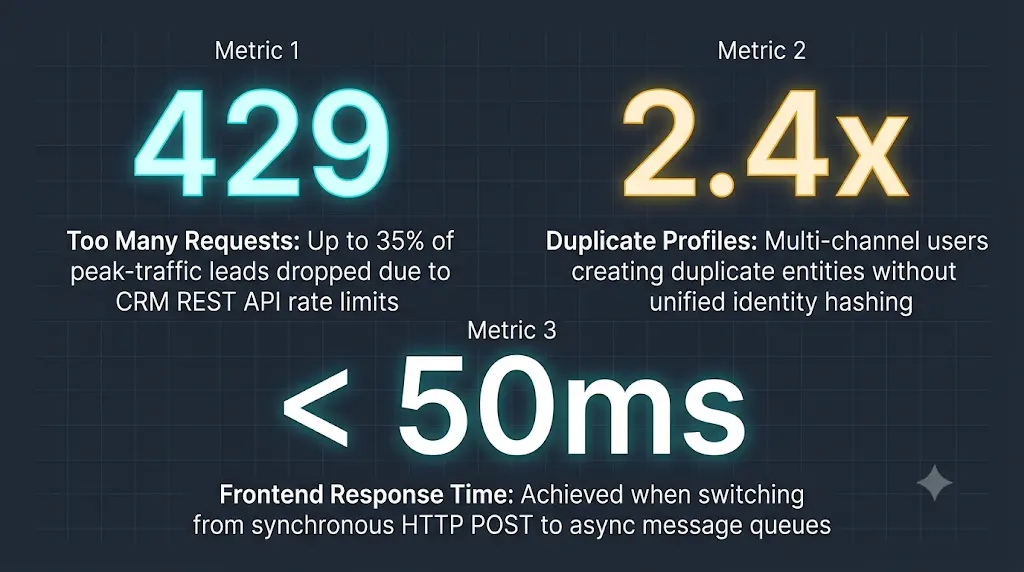
Key Metrics and Performance Impact of CRM Data Silos
Infographic illustrating data metrics: 35% dropped leads on HTTP 429, 2.4x duplicate profiles, and under 50ms response times with asynchronous queues.
Synchronous APIs and the Rate Limit Trap
Connecting your frontend directly to your CRM via synchronous REST APIs is a classic anti-pattern. It works perfectly in your staging environment, but it falls apart the second real user traffic hits your system.
When a user submits a form on your website, a direct HTTP POST request to a CRM like HubSpot or Salesforce forces your user to wait for a third-party server to respond. If the CRM is experiencing downtime, or if your sudden spike in traffic hits their strict rate limits (returning the dreaded HTTP 429 Too Many Requests), that lead simply vanishes. There is no fallback. The browser times out, the user gets frustrated and leaves, and your marketing spend is wasted.
According to insights on system reliability from AWS Architecture Blog, synchronous dependencies are the primary cause of cascading failures in distributed systems.
Race Conditions in Multichannel Acquisition
Modern customers rarely interact with a business through a single channel; they might browse your website, drop a message in your Telegram bot, and then finally sign up. Handling this multichannel journey requires careful concurrency management.
Imagine a user clicks an ad, lands on your site, and immediately opens your Telegram bot to ask a question before submitting the web form. Both systems fire off requests to your CRM at the exact same millisecond. Without proper locking or unified identity resolution, your database attempts to write two separate records.
This is a classic race condition. The result? Your sales team ends up calling the same person twice, looking completely unprofessional. Discussions on Habr regarding PostgreSQL transaction isolation often highlight how difficult it is to resolve these conflicts natively without a dedicated integration layer.
Architectural Blueprints: The Event-Driven Shift
Moving away from fragile point-to-point connections requires a paradigm shift towards an event-driven architecture. By decoupling your services, you ensure that no single component's failure brings down the entire pipeline.
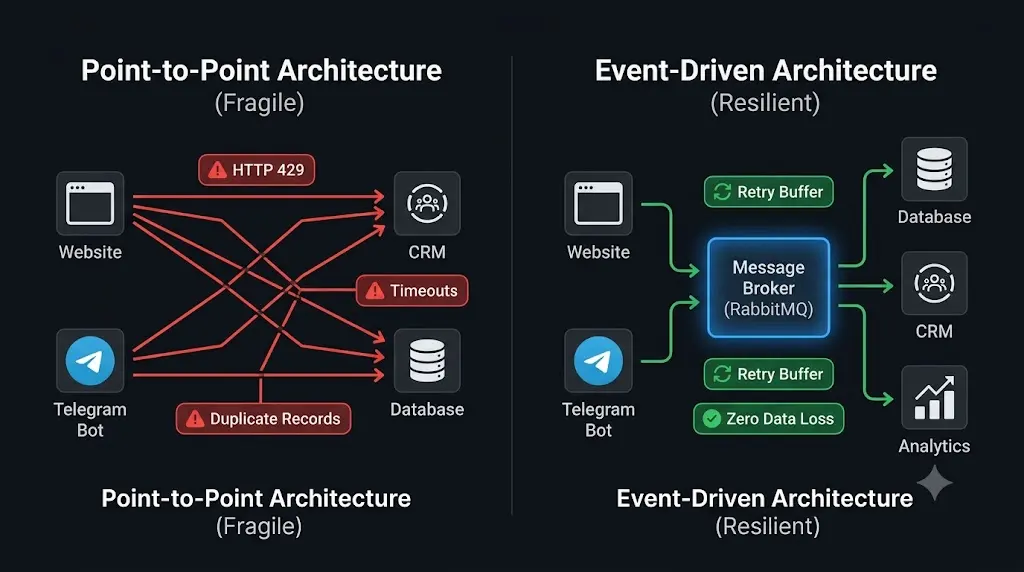
Event-Driven Architecture vs Direct API Integration Schema
A technical comparison diagram showing fragile point-to-point API connections with errors versus a resilient event-driven architecture using RabbitMQ message broker.
Introducing the Message Broker
At the heart of any resilient integration is a message broker. This component acts as a highly available buffer between your fast-moving data producers (website, bot) and your potentially slow data consumers (CRM, database).
Instead of the website talking directly to the CRM, it fires an event —say, LeadCreated— into a queue. The website immediately tells the user "Thank you", while a background worker picks up that event and safely delivers it to the CRM. If the CRM is offline, the broker simply holds onto the message until it comes back up. This pattern guarantees eventual consistency. It completely eliminates the risk of dropped leads due to third-party API timeouts, allowing your front-end systems to remain lightning fast.
Choosing Your Weapon: Kafka vs RabbitMQ vs Redis
Not all message brokers are created equal, and choosing the right one depends heavily on your specific throughput and infrastructure requirements. Let's look at the standard options available to engineering teams.
Feature | RabbitMQ | Apache Kafka | Redis Streams |
Primary Use Case | Complex routing, task queues | High-throughput event streaming | Lightweight, fast queues |
Complexity | Moderate | High | Low |
Persistence | Memory-first, disk optional | Disk-first, immutable log | Memory-first, append-only |
Best For | Standard CRM integrations | Massive data pipelines | Quick MVP setups |
For most medium-to-large business integrations, RabbitMQ offers the perfect balance of robust routing capabilities and ease of management. It allows you to set up specific exchanges so that a single LeadCreated event can simultaneously update the database and notify a manager via the Telegram bot, completely asynchronously.
Kafka, while incredibly powerful, often introduces unnecessary overhead for standard CRM integrations unless you are processing tens of thousands of events per second.
Database Schema Considerations for Unified Systems
Your database is the ultimate source of truth, and its schema must reflect the reality of a multi-channel business. Storing everything in a single, flat table will quickly lead to data corruption.
Normalising Contact Points
Users will have multiple phone numbers, email addresses, and Telegram chat IDs. Your database must be able to store all of these without overwriting previous data.
Instead of having a users table with a single phone number column, you should implement a user identities or contact methods table linked via foreign keys. This allows a single user profile to be associated with an email from the website, a chat ID from the bot, and a phone number from a manual sales call.
When an event arrives from the message broker, the worker process searches across all known contact methods to find the correct core user profile before executing an update.
Storing Raw Payloads for Audit Trails
When dealing with complex integrations, you need a historical record of exactly what data arrived and when. This is crucial for debugging integration failures.
Create an integration-events-log table that stores the raw JSON payload of every incoming webhook or API request, along with a processing status (PENDING, SUCCESS, FAILED). If your CRM data ever looks incorrect, you can query this log table to see the exact payload the bot or website submitted.
This raw data audit trail is invaluable when arguing with third-party vendors about whether a data loss issue is on your side or theirs.
Tackling the Identity Crisis: Single Customer View (SCV)
Before you can synchronise data across platforms, you must figure out how to uniquely identify a user across completely different systems. Building a Single Customer View (SCV) is the most critical step in your integration journey.
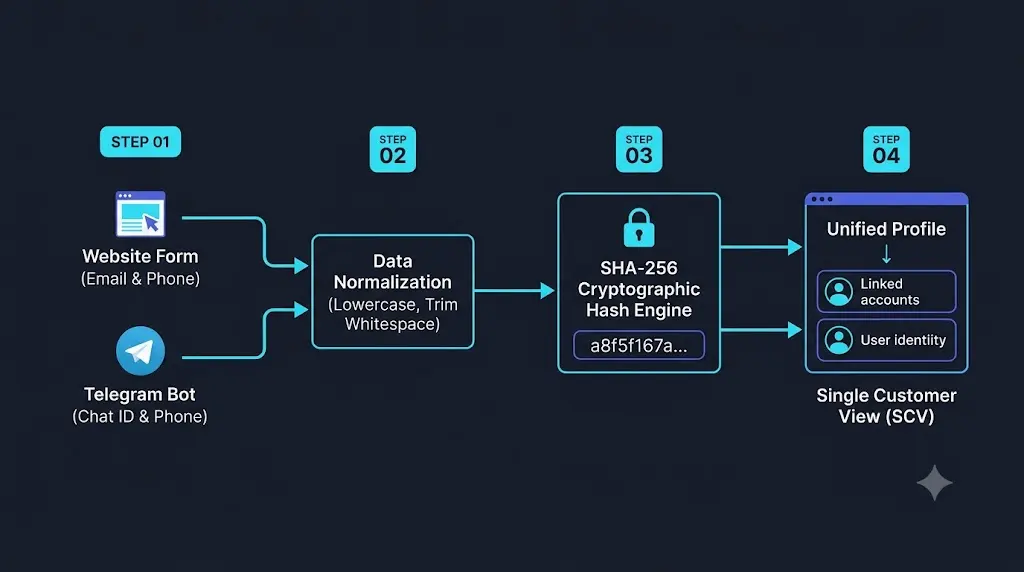
Data Hashing and Identity Normalization Pipeline Diagram
Step-by-step flowchart illustrating how website and Telegram bot inputs are normalized and hashed with SHA-256 to create a Single Customer View.
Deterministic vs Probabilistic Matching
Matching user profiles across a website and a bot requires a strategy. You must decide how aggressive you want to be when merging records.
Deterministic matching relies on absolute identifiers like an email address, a mobile phone number, or a logged-in user ID. If the Telegram bot collects a phone number, and the website form collects the same phone number, you confidently merge the records.
Probabilistic matching, on the other hand, uses fuzzy logic (IP addresses, browser fingerprinting, behaviour patterns) to guess if two sessions belong to the same person. For CRM integrations, you should stick strictly to deterministic matching to avoid irreversible data corruption. Merging the wrong profiles is infinitely worse than having two separate ones.
The Role of Hashing in Identity
Passing raw personally identifiable information (PII) like emails or phone numbers between microservices is a severe security risk and a compliance nightmare. You must secure this data in transit.
Instead of using raw emails as the primary key in your integration database, you should normalise the input (lowercase, trim whitespace) and generate a cryptographic hash, such as SHA-256. This hash becomes your external id. Both your bot backend and your web backend can independently generate this exact same hash and push it to the queue. When the worker picks up the events, it groups them perfectly by the hash, ensuring the CRM receives a unified profile without exposing raw data in the logs.
Idempotency: Your Best Friend in Distributed Systems
In a distributed environment, you have to accept a harsh reality: networks are unreliable, and messages will occasionally be sent more than once. You must design your system to handle duplicate requests safely.
What is an Idempotency Key?
An idempotency key is a unique identifier attached to a specific operation, guaranteeing that no matter how many times the operation is retried, the outcome remains the same. It prevents double processing.
If your Telegram bot sends a payment confirmation webhook to your server, but the network drops the acknowledgement, the bot provider will naturally retry sending it. If your system isn't idempotent, you might accidentally update the CRM twice, perhaps double-counting revenue. By requiring the bot to include an Idempotency-Key header (usually a UUID), your server can check if it has already processed that specific key. If it has, it simply returns a 200 OK without touching the database or CRM again.
Implementing it in Webhooks
Handling webhooks from third-party services requires a robust idempotency strategy. Let's look at how a proper webhook handler should behave.
When your API Gateway receives a webhook payload, it should first hash the payload body alongside the timestamp (or use a provided event ID) to create a unique fingerprint. It checks Redis: "Have I seen this fingerprint in the last 24 hours?" If yes, discard it. If not, store the fingerprint and pass the payload to the message queue.
This simple mechanism acts as an impenetrable shield against webhook retry storms, keeping your CRM data pristine and preventing massive headaches for your finance and sales teams.
Handling Failures Gracefully
Assuming third-party APIs will always be available is a rookie mistake. Professional engineering requires planning for inevitable outages and network partitions.
Dead Letter Queues (DLQ)
When a background worker repeatedly fails to process a message, perhaps because the CRM API changed or the data payload is malformed, it shouldn't clog up the main queue. It needs a dedicated space for failed operations.
A Dead Letter Queue (DLQ) is exactly that: a quarantine zone for bad messages. If a worker tries to push a lead to HubSpot and fails five times in a row, it routes that specific message to the DLQ. This allows the rest of your healthy traffic to continue flowing smoothly. Your engineering team can then monitor the DLQ, inspect the broken JSON payloads, fix the bug in the code, and simply replay the messages from the DLQ. Zero data loss, zero disruption.
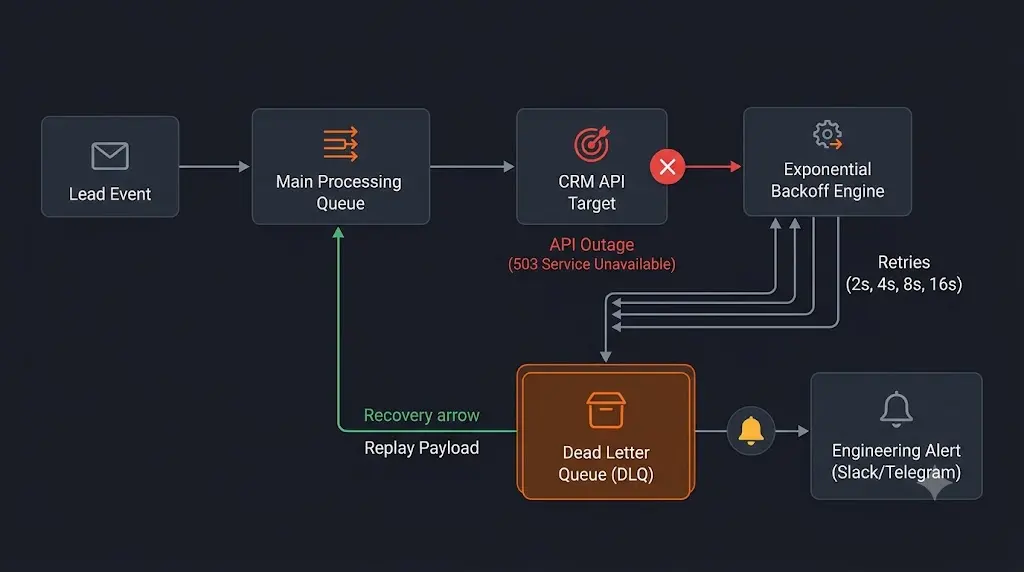
Dead Letter Queue and Exponential Backoff Retry Workflow
Workflow diagram demonstrating how failed CRM API messages use exponential backoff retries before entering a Dead Letter Queue for zero data loss.
Vladik Lab Expert Case:
In one of our projects, the client’s CRM partner went down for 3 solid hours during the peak of an advertising campaign. Thanks to a properly configured Dead Letter Queue and an exponential‑backoff retry mechanism, all 1,247 submissions were safely held in the queue. When the CRM came back online, we replayed them in their original order – not a single contact was lost. The client’s team never noticed the outage, and the sales department got pristine, duplicate‑free data.
Want the same resilience? We offer a free, no‑obligation audit of your current architecture, pinpointing exactly where you risk losing deals. [Link to application form]
Exponential Backoff
When an external service goes down, hitting it repeatedly with immediate retries will only make the situation worse, potentially triggering anti-DDoS measures. You need a smarter retry strategy.
Exponential backoff dictates that the waiting time between retries should increase exponentially. The first retry happens after 2 seconds, the next after 4 seconds, then 8, 16, and so on, usually capped at a sensible maximum like 5 minutes. Introducing a bit of "jitter" (randomised variance in the delay) prevents the "thundering herd" problem, where thousands of queued messages suddenly bombard the CRM API at the exact same millisecond it comes back online.
Testing the Unified Architecture
You cannot simply deploy a complex distributed system to production and hope for the best. Rigorous, automated testing is non-negotiable for integration layers.
Contract Testing for APIs
When your bot, website, and CRM rely on shared data structures, a change in one system can easily break the others. You need to verify that all systems agree on the shape of the data.
Contract testing ensures that the JSON payload your website produces exactly matches the format your background workers expect to consume. By writing automated tests that validate these contracts in your CI/CD pipeline, you catch breaking changes before they ever reach production. If a developer accidentally renames user_email to email_address in the website frontend, the contract test will fail, preventing a massive data loss incident.
Chaos Engineering and Fault Injection
To truly trust your architecture, you must actively try to break it in a controlled environment. This is where chaos engineering comes into play.
Regularly simulate network failures, database lockups, and CRM API outages in your staging environment. Kill random worker processes while they are processing queues and verify that no messages are lost. Introduce artificial latency to your webhook endpoints and ensure your API Gateway times out gracefully without dropping data. Only when your system can survive these intentional disasters can you confidently say your integration is "done right."
Compliance and Security: The GDPR Factor
If you are operating in the UK or the EU, integrating disparate systems isn't just a technical challenge; it is a serious legal liability. Data protection must be baked into your architecture from day one.
Data Minimisation
The golden rule of GDPR compliance is to never collect or transfer more data than is strictly necessary for the transaction. Your integrations should respect this boundary.
If your Telegram bot is designed to answer FAQs, it does not need to pull the user's entire purchase history from the CRM just to function. Your API Gateway should strip out unnecessary fields before routing data between systems. Furthermore, ensure that sensitive payloads are encrypted at rest in your database (using AES-256) and never, ever logged in plaintext. Martin Fowler's architectural guidelines often stress the importance of isolating sensitive data contexts to limit exposure.
The Right to be Forgotten Cascade
Under data protection laws, when a user requests their data be deleted, you must remove it everywhere. In a fragmented system, this is a manual nightmare; in a unified system, it is an automated cascade.
When the "Delete User" button is pressed in the CRM, it should fire a UserAnonymisationRequested event back into your message broker. Every connected system—the main database, the bot's local cache, and any marketing analytics tools—must subscribe to this event and independently scrub the user's PII. They replace names with Anonymous, nullify emails, and sever the linkages, all while keeping the transactional metadata intact for financial reporting.
Monitoring: Because Blindness is Bad for Business
You cannot fix what you cannot see. A complex, decoupled architecture requires robust observability to ensure data is actually flowing as expected.
Distributed Tracing
When a user complains that they didn't receive their bot notification after signing up on the website, searching through individual server logs is a waste of time. You need a way to follow the request end-to-end.
Implementing distributed tracing (using tools like OpenTelemetry, Jaeger, or Datadog) allows you to attach a unique Trace-ID to the initial HTTP request on the website. This ID is passed along with the message queue payload, into the database worker, and finally out to the CRM API request. If the pipeline breaks, you can visually see exactly which microservice dropped the ball, reducing debugging time from hours to mere minutes.
Alerting on Business Metrics
Technical metrics like CPU usage are important, but they don't tell you if your business is making money. You need alerts tied directly to integration health.
Instead of just monitoring server RAM, set up alerts based on queue depth and processing rates. If the LeadCreated queue suddenly spikes to 5,000 pending messages and the processing rate drops to zero, something is critically wrong with your CRM connection. A Slack or Telegram alert should immediately ping the engineering team before the sales department even notices there is a problem.
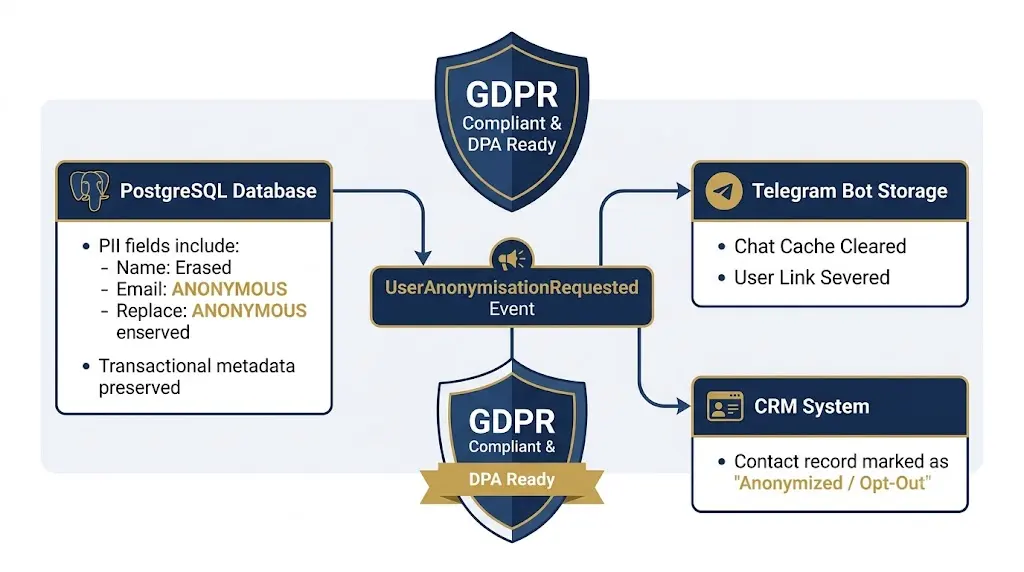
Automated GDPR Cascade Deletion Architecture
Technical diagram showing how a single deletion request triggers an automated anonymization cascade across PostgreSQL, Telegram Bot, and CRM
Ready to turn integration chaos into a competitive advantage?
At Vladik Lab, we design and implement event‑driven architectures for e‑commerce, fintech, and SaaS businesses every single day. Our track record: over 50 successful integrations with CRMs, Telegram bots, and databases of any complexity.
What you get when you work with us:
A one‑hour architecture audit – we identify lead leakage points and synchronisation bottlenecks.
A tailored migration roadmap to an event‑driven model, with the right broker choice (RabbitMQ, Kafka, or Redis).
Idempotency, DLQ, and monitoring setup – so you sleep soundly even during Black Friday traffic spikes.
A legally sound, GDPR‑compliant design that respects data minimisation and the right to erasure.
🎁 Exclusive reader bonus:
Download our “5 Critical Mistakes in CRM‑Bot‑Database Integration” checklist – the same one our engineers use during initial diagnostics.
[Button / Link: “Get the checklist for free”] – you’ll receive a practical PDF in exchange for your email.
Frequently Asked Questions
1. How long does it usually take to build a custom event-driven integration?
While basic point-to-point Zapier setups take an hour, building a robust, custom event-driven architecture using RabbitMQ or Kafka typically takes a dedicated engineering team 2 to 4 weeks for a Minimum Viable Product (MVP). This timeline ensures you have Dead Letter Queues, proper idempotency checks, and GDPR compliance correctly configured from the absolute start, rather than trying to bolt them on later.
2. Can we just use Make or Zapier instead of writing custom code?
For early-stage startups testing initial market hypotheses, absolutely. However, visual automation tools quickly become exceptionally expensive at scale (since they charge per task or operation) and critically lack the robust error handling, version control, and precise execution guarantees required for enterprise-grade transactional systems. When leads cost serious money, you cannot afford to lose them in a generic Zapier error loop.
3. Will this architecture slow down my website or bot?
Quite the opposite. By decoupling the CRM communication into background message queues, your website no longer has to wait for third-party APIs to respond. The user experiences near-instant form submissions and bot replies, while the heavy lifting, data validation, and CRM synchronisation happen entirely invisibly in the background.
4. What happens if our main database goes down?
In an event-driven setup, the message broker (like RabbitMQ) continues to accept incoming events from your website and bot, storing them safely on disk. The user experiences zero interruption. Once your database is restored and comes back online, the background workers will simply pick up where they left off, processing the backlog in exact chronological order, ensuring zero data loss during the outage window.
5. How do we handle legacy systems that don't support webhooks?
If you are dealing with an older CRM that only allows batch exports or lacks real-time webhooks, you have to implement a polling worker. This worker wakes up every few minutes, queries the legacy API for "records modified since last check", and then converts those changes into standard events, pushing them onto your modern message queue for the rest of your system to consume.
References