You launch a brilliant marketing campaign. The traffic flows, clicks are cheap, and potential customers are landing straight in your Telegram channel. They hit the "Start" button, ready to engage. What happens next usually dictates whether you secure a loyal client or lose them to a competitor in seconds.
If they are greeted by a sterile wall of text and a rigid grid of grey inline buttons, you are actively burning your marketing budget. Modern consumers do not want to text a robot to buy a t-shirt, book a haircut, or schedule a consultancy call. They want a visual, fluid, and intuitive shopping experience. They want the power of a full website without ever leaving their favourite messenger.
This is the exact problem the Telegram Mini App (TMA) was designed to solve. We have officially moved past the era of rudimentary chat interfaces. If you want to turn your Telegram presence into an automated, high-converting sales machine, relying solely on a text bot is no longer enough. You need a fully-fledged Mini App. Here is why the structural shift is happening, and exactly how you can capitalise on it.

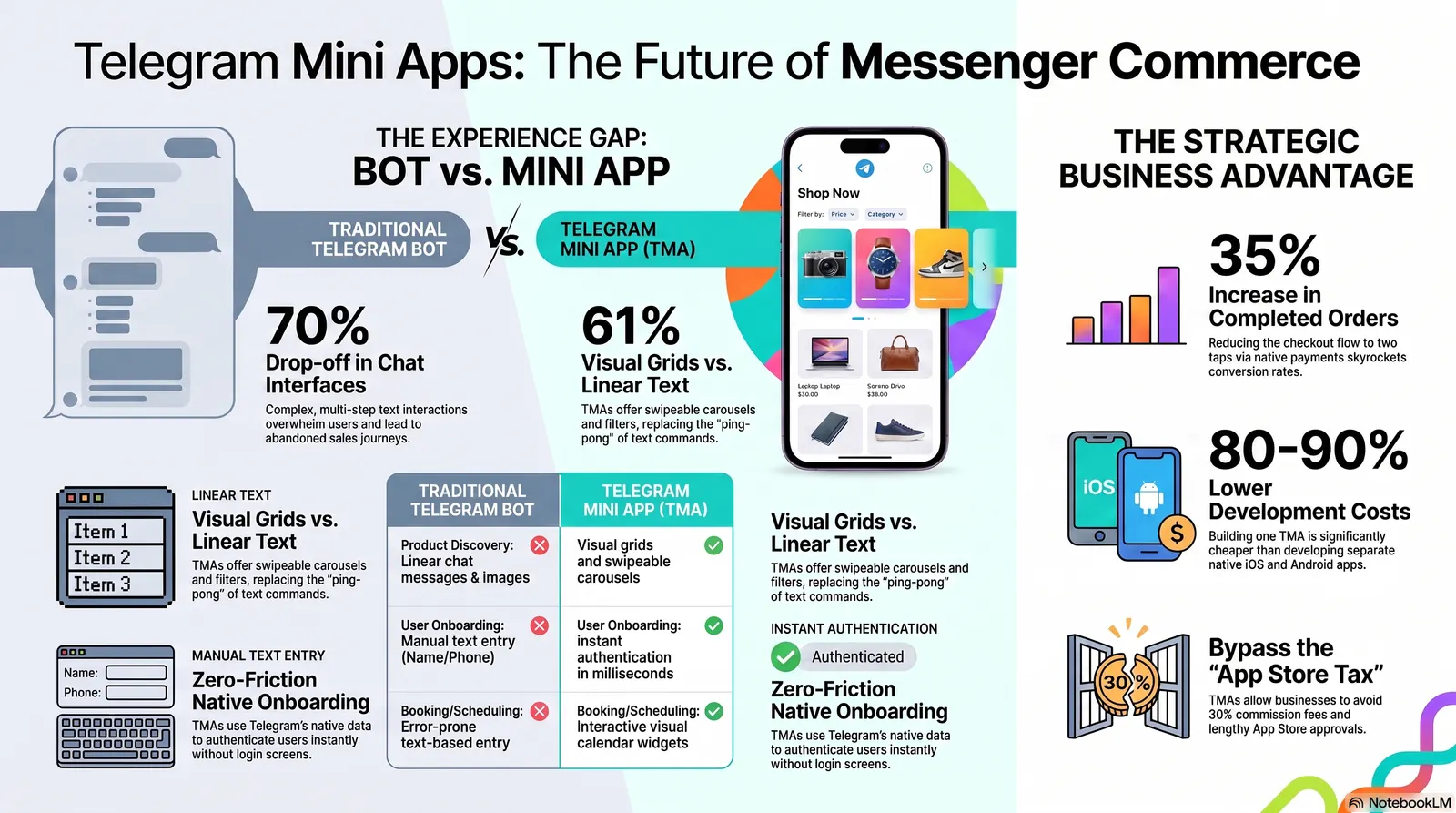
Comparing Traditional Chatbots and Telegram Mini Apps Interface
Alt Text: Side-by-side comparison showing a cluttered text-based Telegram bot on the left and a clean, interactive Telegram Mini App interface on the right.
The Core Difference: Why a Chat Interface Limits Your Revenue
Understanding the architectural and experiential difference between a standard bot and a Mini App is the foundational step in upgrading your conversion strategy.
The Problem with Traditional Bots
Bots were an undeniable revolution when they first appeared on the scene. They allowed basic programmatic interaction within a chat window, enabling businesses to automate FAQs and simple lead generation. However, they rely entirely on a conversational user interface (CUI). When a user wants to browse a product catalogue, the bot is forced to send separate messages containing an image, a description, and an inline keyboard.
If the user wants to compare two items or change a parameter, they must scroll up and down the chat history, triggering new messages with every click. It is a linear, clumsy process that creates immense friction. According to deep dives into user experience behaviour on VC.ru, forced multi-step chat interactions lead to a drop-off rate of up to 70% before the user even reaches the checkout stage. The cognitive load is simply too high.

User Drop-off Rate in Text Bots vs Mini Apps
Alt Text: Conversion funnel chart illustrating a steep 70 percent drop-off in multi-step chatbot flows compared to a smooth user flow in Mini Apps.
Enter the Telegram Mini App
A Telegram Mini App is an entirely different beast. It is a fully functional web application (typically built with React, Vue, or native HTML5) that opens directly inside the Telegram interface. When the user taps a custom menu button or an inline link, a sleek web view slides up from the bottom of the screen.
They are instantly transported inside a branded, interactive environment that looks and feels exactly like a native iOS or Android application. You control the colour scheme, the typography, the layout, and the animations. The user can swipe, scroll horizontally, use visual filters, and interact with dynamic elements, all while Telegram runs seamlessly in the background.
Telegram Bot vs Mini App: A Side-by-Side Comparison
To truly grasp the operational gap between the two technologies, we need to look at how each system handles fundamental business tasks. The contrast in user experience directly correlates to your bottom line.

Key Feature Comparison: Telegram Bot vs Mini App
Alt Text: Infographic dashboard comparing Product Discovery, Authentication, Shopping Cart, and Payment flows between bots and Mini Apps.
Feature / Capability | Traditional Telegram Bot | Telegram Mini App (TMA) | Business Impact |
Product Discovery | Linear chat messages. Requires sending new images and text blocks for every single item. | Visual grid layouts, swipeable carousels, category tabs, and real-time search bars. | Higher engagement. Users browse more products when the interface is visually stimulating and easy to navigate. |
User Onboarding | Often requires the user to type out their name, phone number, or email address manually. | Zero-friction. Uses Telegram's native initData to instantly authenticate the user in milliseconds. | Eliminates the login barrier, which is globally recognised as a primary cause of cart abandonment. |
The Shopping Cart | Non-existent or clunky. Requires the user to type "Cart" to view a text summary of their order. | A dynamic, "sticky" cart button that stays on screen, updating the total price in real-time as items are added. | Increases Average Order Value (AOV) by making it effortless to review and modify purchases. |
Booking & Scheduling | Text-based date entry (e.g., "Type date as DD.MM.YY"). Highly prone to user formatting errors. | Interactive, visual calendar widgets where users tap available dates and time slots. | Drastically reduces administrative errors and eliminates the frustrating "ping-pong" of scheduling. |
Why E-Commerce Needs Mini Apps Right Now
If you are selling physical or digital goods, the transition from a standard chatbot to a Mini App is no longer just a nice-to-have upgrade; it is a baseline consumer expectation. The modern shopper has been conditioned by global retail giants to expect instantaneous visual feedback.
Visual Shopping and the "Sticky Cart"
Think about the standard e-commerce journey. A buyer wants to filter running shoes by size, colour, and price range. In a chat bot, this requires a tedious back-and-forth ping-pong match of text commands. Inside a Telegram Mini App, the user simply taps visual filter boxes. The interface dynamically updates without refreshing or sending annoying notification pings.
Furthermore, the "sticky cart" remains persistently visible at the bottom of the screen. Users can add items, adjust quantities, and watch their total order value calculate instantly. This mirrors the exact behaviour of top-tier mobile websites, keeping the user entirely focused on the purchasing decision rather than figuring out how to navigate the chat interface.
Business of Apps
Zero-Friction Checkout and Payments
Cart abandonment is the silent killer of online retail. A massive contributor to this metric is the dreaded account creation screen. With TMAs, the concept of a login screen is completely eradicated. Because the user is already authenticated by Telegram, the Mini App securely receives their unique payload instantly. You already know who they are, and you can pull their preferred language and profile details immediately.

Impact of Two-Tap Native Checkout on E-Commerce Sales
Alt Text: Key metric visual highlighting a 35 percent increase in completed orders when reducing checkout steps from four to two.
When it comes to payment, the friction drops to absolute zero. Selling inside Telegram allows you to integrate with major payment gateways like Stripe, local acquiring banks, or Web3/TON networks. The user can complete the purchase using Apple Pay or Google Pay in just two taps. According to a global analysis of mobile commerce trends by Statista, reducing a checkout flow from four steps to two can increase completed orders by over 35%.
Service Businesses: Bookings Without the Ping-Pong
Service-based models face unique challenges in messenger marketing, primarily around scheduling, resource allocation, and capturing precise client requirements.
Calendars and Interactive Selection
Imagine running a premium medical clinic, a legal consultancy, or a high-end salon. A client wants to book an appointment for next Tuesday. A traditional bot asks: "Please type your preferred date". The client makes a typo, the bot throws an error, and the client gives up out of sheer frustration.
A Telegram Mini App replaces this antiquated flow with a sleek, interactive calendar widget. The user visually taps the date, sees available time slots dynamically pulled directly from your internal CRM, selects their preferred specialist from a photo grid, and confirms. No text is ever typed. The friction drops to zero, and your front desk saves hours of administrative back-and-forth.
Complex Forms and Questionnaires
Many B2B services require extensive lead qualification before a call can be booked. Asking a user to answer ten consecutive questions in a chat thread feels like an interrogation. Inside a Mini App, you can present a beautifully designed, multi-step form with sliders, drop-down menus, and file upload buttons. It feels professional, secure, and significantly less invasive, leading to higher completion rates for high-ticket service inquiries.
The Synergy: Why You Still Need a Bot
A common misconception is that building a Mini App means you should delete your chat bot entirely. In reality, it is vital to understand that a Mini App does not kill the bot; rather, it elevates the bot to its true, most profitable calling.
Retention and Push Notifications
You do not build a Mini App to exist in a vacuum. The chat bot becomes your ultimate customer retention and communication tool. Once a user completes a purchase or books a service inside your Mini App, the bot takes over the post-purchase workflow. It instantly delivers the digital receipt, tracks the delivery status, and automatically asks for a review a week later.
Rescuing Abandoned Carts
More importantly, the bot acts as an automated sales recovery agent. If a user adds an item to their cart inside the Mini App but closes Telegram before paying, your system can automatically trigger an abandoned cart reminder via the bot two hours later: "Hey, you left this in your cart. Here is a 5% discount to complete your order." This dual-engine approach: where the Mini App handles the visual sale and the Bot handles the persistent re-engagement—is detailed in OmiSoft's Telegram Strategy Guide as the gold standard for high-converting messenger funnels.
Development and Cost: Beating the App Store Monopoly
Developing proprietary software has historically been a massive capital expenditure, heavily guarded by the strict rules and exorbitant fees of tech giants. Telegram fundamentally disrupts this monopoly.
Cross-Platform from Day One
Building a native iOS app and a separate Android app requires two distinct development teams, a massive upfront budget, and months of waiting for App Store approvals. Furthermore, getting a user to actually leave your social media channel, navigate to the App Store, download a 150MB file, and register is incredibly difficult.
A Telegram Mini App is built once using standard web technologies. It runs flawlessly on iPhones, Android devices, and desktop computers right out of the box. Data published in Softean's Mini App Development Breakdown demonstrates that building a cross-platform Telegram Mini App reduces development expenses by 80% to 90% compared to building separate native iOS and Android apps. As noted in the official Telegram developer documentation, this architecture is engineered to give businesses complete deployment agility.
Instant Updates and Zero Commission
Pushing an update to a native app can take days of review. With a TMA, pushing an update takes seconds. You change the code on your server, and every single user instantly sees the new version the very next time they open the app. Best of all, you bypass the 30% commission fees charged by traditional app stores on digital goods, keeping your margins intact.
Real-World Data: Who is Already Winning?
We are not talking about a theoretical future; the shift is happening rapidly right now across multiple international and regional markets.
Market Adoption and CTR Metrics
With Telegram surpassing 1 billion active monthly users globally (as documented in demographics research by DemandSage), the audience is primed for native commerce. Case studies compiled by advertising networks like RichAds show that interactive Mini App funnels yield click-to-conversion rates over 15%, significantly outperforming standard display ads.
In technical communities such as Habr, developers and product managers regularly publish detailed breakdowns showing how B2B companies are using TMAs for complex client onboarding. These businesses are reducing client acquisition costs by bypassing traditional external landing pages entirely.
Gamification and Viral Mechanics
Innovative brands are also leveraging TMAs for gamification. Because the Mini App is a full web canvas, you can build interactive loyalty programmes, spin-the-wheel discount games, or referral dashboards directly into the interface. Users can share their referral links to other Telegram chats with a single tap, creating viral, organic growth loops that traditional websites struggle to replicate.
How to Transition Your Business (The Yladick Lab Approach)

End-to-End Telegram Mini App and CRM Integration Flow
Alt Text: Diagram showing seamless data flow from Telegram Mini App through automated webhooks into a central business CRM.
Knowing the technology is superior is only half the battle; implementing it seamlessly into your existing operations without breaking your current workflow is the real challenge.
Strategic Integration with Your CRM
You cannot afford to have your Telegram sales channel isolated from your main business infrastructure. At Yladick Lab, we do not just design pretty interfaces; we architect end-to-end digital ecosystems. When a customer places an order or books a slot via your new Telegram Mini App, that data must flow instantly into your central CRM, update your inventory software, and trigger the correct automated marketing workflows.
Whether you are scaling a bespoke e-commerce brand or managing a high-volume service business, we build the precise, secure bridge between Telegram's vast user base and your internal business logic. We handle the complex API connections so you can focus on fulfilling the surge in new orders.
Frequently Asked Questions (FAQ)
1. Do my customers need to download anything extra to use the Mini App?
Absolutely not. That is the primary advantage of this technology. If they have the standard Telegram application installed on their phone or computer, the Mini App opens instantly within the chat interface. There are no secondary downloads or plugins required.
2. Can I link my existing website catalogue to the Telegram Mini App?
Yes. A professionally developed Mini App can be directly hooked into your existing database (such as Shopify, WooCommerce, or a custom backend via REST APIs). If you change a price or update an image on your main website, it automatically reflects inside your Telegram Mini App in real-time.
3. Are payments processed safely?
Extremely safely. Telegram acts as a secure bridge, but the actual transaction is processed by established, bank-grade payment providers (like Stripe, local acquiring banks, or native Apple/Google Pay integration). Telegram does not store your customers' credit card details, ensuring full compliance and peace of mind for your buyers.
4. Will I lose the conversational aspect of my brand?
Not at all. The Mini App handles the heavy lifting: browsing, filtering, and paying. However, the user can always close the app and type a question directly to your customer support team (or an AI-powered support bot) in the same chat window. It offers the best of both worlds: robust commerce and personal communication.
5. How long does it take to build a custom Mini App?
This heavily depends on the complexity of your requirements. A streamlined MVP storefront integrated with a standard CRM can be deployed in 4 to 6 weeks. Highly custom service booking platforms with unique calendar logic take slightly longer. Proper architectural planning before writing code is the key to a fast rollout.
6. Is a Mini App only for large enterprises?
No. In fact, small to medium-sized businesses benefit the most. Because TMAs bypass the massive costs of developing native iOS/Android apps, they allow independent service providers, boutique stores, and individual consultants to offer an enterprise-grade mobile experience on a fraction of a corporate budget.